Best Shopify Blog Automation App in 2026: What to Look For Before You Install
Compare what really matters in a Shopify blog automation app, from product sync and editor quality to recurring workflows, images, and SEO controls.

Alex Mercer
Lead AI Engineer
Introduction
Most merchants do not need “an AI writer.” They need a system that can turn store data into publishable content consistently, without breaking their workflow or creating more cleanup work than it saves.
That is why choosing the best Shopify blog automation app is not about who can generate a paragraph the fastest. It is about which tool helps you publish better content more consistently and tie that content back to real products, collections, and revenue goals.
Reality Check
What blog automation should actually solve
If an app only gives you raw text, you still have to do the hard parts yourself: choose topics, build structure, add metadata, place links, find images, polish the article, and publish it properly inside Shopify.
A better automation product should reduce friction across the whole workflow.
- Topic generation that makes sense for your catalog and audience
- Clean outlines and usable structure before generation
- Image handling that does not create design debt
- Publishing controls for timing, language, and brand voice
- Editorial review tools so the output can still be refined
Evaluation
The feature checklist merchants should care about
Must-have capabilities
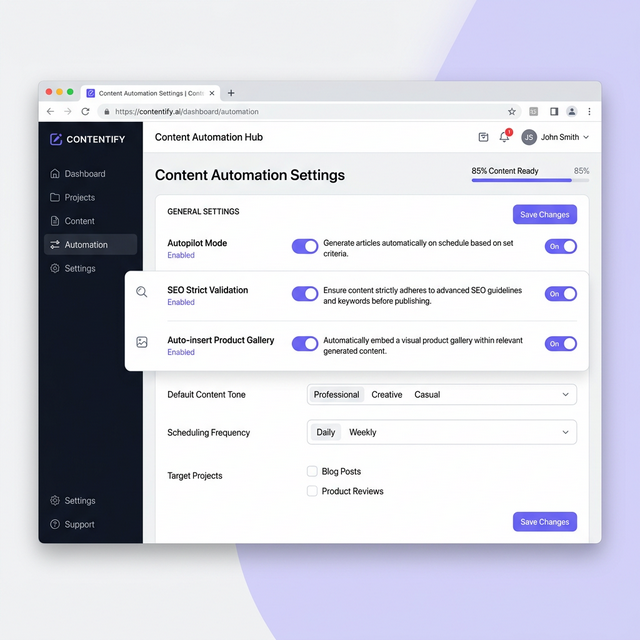
- Recurring Auto-Pilot publishing
- Manual article generation for one-off content
- Product and collection support
- Metadata and final editor controls
- Language and tone configuration
Common weak spots
- No product-level context
- No useful review workflow after generation
- Generic content with no store specificity
- Poor documentation or unclear setup
- Automation without schedule transparency
Differentiator
Why product-led content is a real advantage on Shopify
Shopify stores already have the most important content source sitting in the catalog: product titles, descriptions, features, use cases, and merchandising structure.
A strong automation app should turn that store data into buying guides, care articles, comparison posts, and decision-support pages. That is much more useful than publishing generic SEO articles that barely match what the merchant actually sells.
This is where AutoBlog AI is especially strong: it supports storewide content, Product-Led Auto-Pilot, and manual product article creation.
Workflow
Do not ignore the editor, scheduling, and docs
The best app is rarely the one with the flashiest AI headline. It is usually the one merchants can trust every week without confusion.
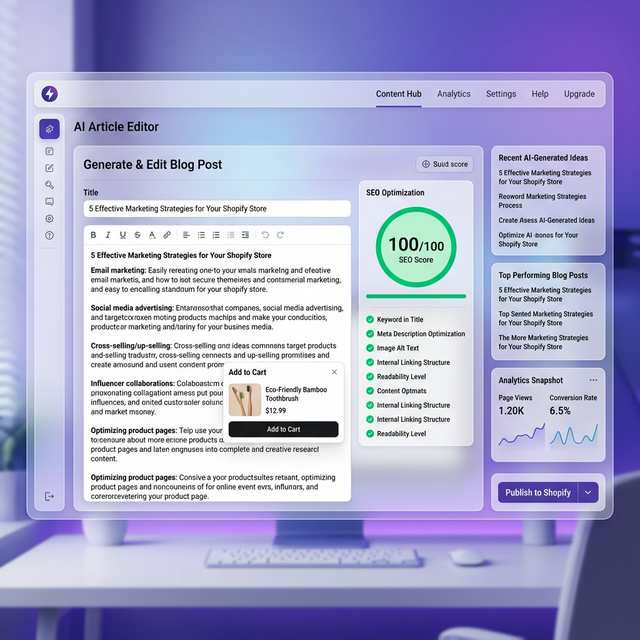
- Can you review what is scheduled next without guessing?
- Can you pause, edit, or delete automations quickly?
- Can you manually refine the article before it goes live?
- Is the documentation strong enough that a merchant can self-serve?
Recommendation
Why AutoBlog AI is a strong option for Shopify merchants
If you want one tool that covers both automation and editorial control,AutoBlog AI is a strong fit.
- Storewide Auto-Pilot for recurring educational content
- Product-Led Auto-Pilot for catalog-driven articles
- Manual Article Creator for one-off campaigns
- Product Article Creator for conversion-focused posts
- Editor workflow for quality score, metadata, and final review
- Documentation hub that explains the full workflow clearly
If you are comparing tools right now, the fastest next step is to open the Shopify App Store listing or review the AutoBlog AI documentation hub.
FAQ
Frequently Asked Questions
Is blog automation safe for Shopify stores?
Should I choose storewide or product-led automation first?
Can one app cover both automated and manual workflows?
Next Step
Compare less. Publish more.
If you want a Shopify-native blog workflow with recurring automation, manual control, product-led content, and strong documentation, start with AutoBlog AI.